Finding Allies, Building Alliances: 8 Elements that Bring--and Keep--People Together by Mike Leavitt & Rich McKeown
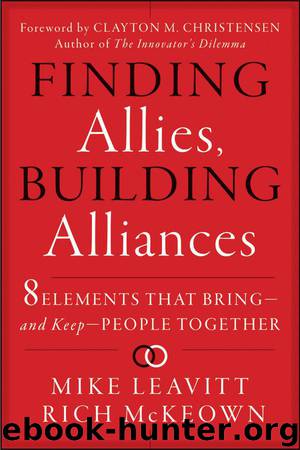
Author:Mike Leavitt & Rich McKeown [Leavitt, Mike]
Language: eng
Format: mobi
Publisher: Wiley
Published: 2013-08-11T14:00:00+00:00
THE ESSENTIAL INGREDIENTS
Charters function like a combination of bylaws and operating plan. There is no magic format. In some cases charters are negotiated between parties for weeks. Others amount to quick documents drafted among peers.
The Western Regional Air Partnership (WRAP) evolved from an earlier collaboration, the Grand Canyon Visibility Transport Commission, a collaboration of federal, state, and local governments, Indian tribes, businesses, and others. WRAP was created to implement a solution to the problem of pollution in the air over the Grand Canyon. We’ve included parts of the charter here (see the Appendix for full charter) to give you a sense of the types of issues it covers. It’s divided into three sections: Purposes, Principles, and Operating Procedures. The Purposes section defines the scope of WRAP in the form of nine statements, including “Develop a common understanding of current and evolving regional air quality issues in the West.” Principles, which is the shortest section in the charter, recognizes the limits of the partnership’s responsibility and notes the federal government’s responsibility to protect tribal resources. And Operating Procedures covers a wide range of issues, from how decisions will be made to the powers of the WRAP board of directors.1
Instead of reviewing every part of the charter, this chapter focuses on the crucial parts, the ones that play the most significant role in helping create a value alliance.
First, the Purpose section helps participants set parameters for its work. It may seem obvious why a collaboration was formed, but in many instances, participants have different ideas about how to solve the problem it faces, how the problem should be defined, or what other problems might be included in their efforts. For instance, we noted that one purpose in the WRAP charter was “understanding . . . evolving air quality issues in the West.” Thus, the scope was defined more broadly than it might have been, in part because pollution in areas relatively far from the Grand Canyon could still affect air quality above it.
Second, the Principles section gives participants a chance to discuss the larger values and concerns behind their upcoming work. In the WRAP charter, this section expressed sensitivity to tribal lands and peoples, and acknowledging this principle meant that it had to be considered when making any decision. Expressing higher-level beliefs and values gives the formal charter moral weight—it’s not just a document of procedures but one of principles.
Third, the Operating Procedures section sets out some practical basics. It is where a collaboration structure becomes very helpful in helping alliance members deal with conflicts and impasses that might otherwise stymie their efforts.
The details of a formal charter may seem simple, but getting these basics right will provide a strong foundation for an alliance as it moves forward. Here are the matters a charter must address as well as why they’re important:
Who the members will be: The composition of the alliance can be a challenge to articulate. In most cases the convener will have assembled the group. However, it is not unusual to discover that a perspective is missing or for a new player to ask for inclusion.
Download
This site does not store any files on its server. We only index and link to content provided by other sites. Please contact the content providers to delete copyright contents if any and email us, we'll remove relevant links or contents immediately.
Hit Refresh by Satya Nadella(9116)
The Compound Effect by Darren Hardy(8918)
Change Your Questions, Change Your Life by Marilee Adams(7732)
Nudge - Improving Decisions about Health, Wealth, and Happiness by Thaler Sunstein(7689)
The Black Swan by Nassim Nicholas Taleb(7097)
Deep Work by Cal Newport(7057)
Rich Dad Poor Dad by Robert T. Kiyosaki(6596)
Daring Greatly by Brene Brown(6501)
Principles: Life and Work by Ray Dalio(6403)
Playing to Win_ How Strategy Really Works by A.G. Lafley & Roger L. Martin(6207)
Man-made Catastrophes and Risk Information Concealment by Dmitry Chernov & Didier Sornette(6001)
Big Magic: Creative Living Beyond Fear by Elizabeth Gilbert(5745)
Digital Minimalism by Cal Newport;(5745)
The Myth of the Strong Leader by Archie Brown(5491)
The Slight Edge by Jeff Olson(5405)
Discipline Equals Freedom by Jocko Willink(5373)
The Motivation Myth by Jeff Haden(5202)
The Laws of Human Nature by Robert Greene(5155)
Stone's Rules by Roger Stone(5078)
